
Rising Carbon Costs Make Decarbonisation a Business Opportunity
The EU has priced carbon emissions since 2005 as part of the EU Emission Trading System. As emissions trading rules tighten, affected companies must factor carbon costs into operations and long-term investments.
EU ETS1 makes emissions a business cost
Launched in 2005, the EU Emissions Trading System (ETS1) prices emissions from heavy industry, power generation, aviation and shipping. The system aims to reduce emissions by 62% by 2030 compared to 2005 levels. The EU caps emissions by issuing a limited number of allowances, each representing one tonne of CO₂-equivalent. Companies must surrender allowances matching their emissions, purchasing additional ones if needed. The cap decreases over time, encouraging emissions reductions and investment in cleaner technologies.
EU ETS2 expands the scope of carbon pricing
From 2028, EU ETS2 will cover emissions from fuels used in road transport, building heating, construction and industries outside ETS1, with national extensions covering agriculture and forestry. All allowances will be auctioned, unlike ETS1, which also provides free allowances. The initial annual emissions cap is approximately 1 billion tonnes of CO₂. From 2028 onwards, this cap will decline annually by more than 5% relative to 2025 emissions.
Turning carbon costs into competitive advantage
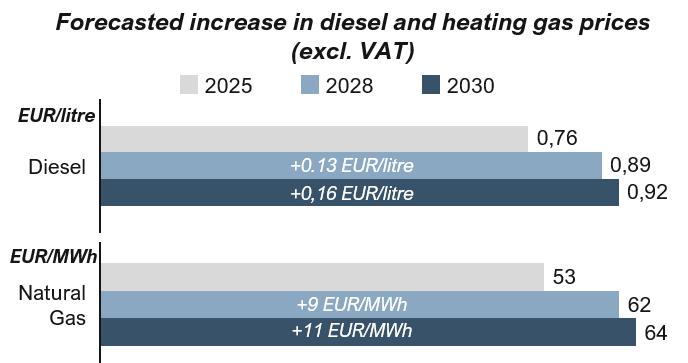
EU ETS2 could result in €50 billion in allowance costs for affected industries in 2028. The estimated fuel price increases ~15% for petrol and diesel and ~20% for heating oil and gas, although actual impacts remain uncertain and will vary over time. Companies should assess their exposure and evaluate to invest in energy efficiency, electrification and lower-carbon alternatives. This will protect margins and enable a competitive advantage in the long run.
Triathlon assists clients to identify, quantify and reduce costs and emissions
Triathlon combines financial and decarbonisation expertise to enable business-driven sustainability. This supports companies to advance towards a sustainability positioning that fulfils stakeholder requirements while remaining competitive.
